Ui
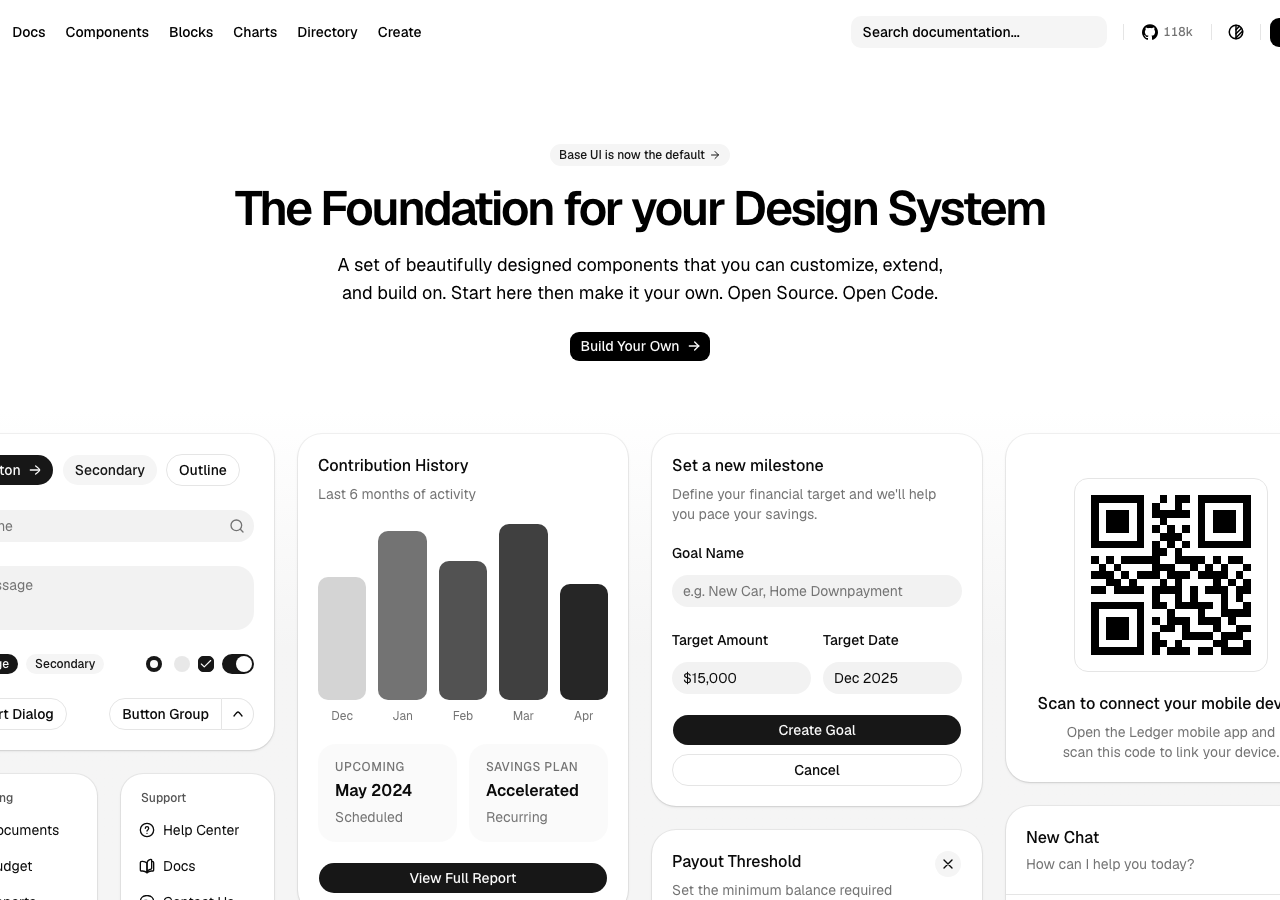
ui.shadcn.comThe reference for a strictly monochromatic, border-first component system where hairline #e5e5e5 dividers do all the structural work and a single filled-black button is the only accent on a pure-white canvas.
Developer Tool flagship
Design tokens
background
surface
text
textMuted
accent
border
- display
- Geist
- body
- Geist
- mono
Do / Don't
Reference it for
- Zero-colour palette: pure white #ffffff canvas, near-black #0a0a0a text, and #e5e5e5 hairline borders as the sole separators (no shadows for elevation).
- One-accent discipline: the entire page has exactly one filled-black button (New Project) that reads as emphasis precisely because everything else is outlined.
- Tight architectural hero: Geist at ~48px weight 600 with -0.05em letter-spacing, centred, over a muted grey subhead at ~18px.
- Pill kicker above the H1 (New preset commands with a trailing arrow) in a small outlined chip, restrained and monochrome.
- Component-gallery hero: instead of an image, show a four-column grid of live UI cards (payment form, team invite, settings, chat prompt) as the proof of the system.
- Border-first cards: 14px radius, 1px #e5e5e5 outline, generous internal padding, no drop shadow, so the grid reads like a wireframe.
- Compact utilitarian controls: 10px radius inputs/buttons, muted #737373 helper text, small 12-14px labels in Geist.
- Slim top nav: wordmark plus flat text links (Docs, Components, Blocks, Charts), a pill search field, GitHub star count, and a black CTA at the far right.
Do not copy
- The shadcn/ui slash-mark wordmark and the exact top-nav label set (Docs, Components, Blocks, Charts, Directory, Create).
- Geist and Geist Mono as a default type pairing; the mono-for-body choice is a Vercel house tell, not a universal move.
- The GitHub 114k star-count badge and open-source framing, which only work for a real OSS project.
- The literal hero copy 'The Foundation for your Design System' and 'Open Source. Open Code.'
- The specific demo card content (Kubernetes/Virtual Machine compute selector, two-factor auth card), which is filler, not a real product.
- Treating total absence of colour as a rule: for a branded product this reads as unfinished rather than deliberate.